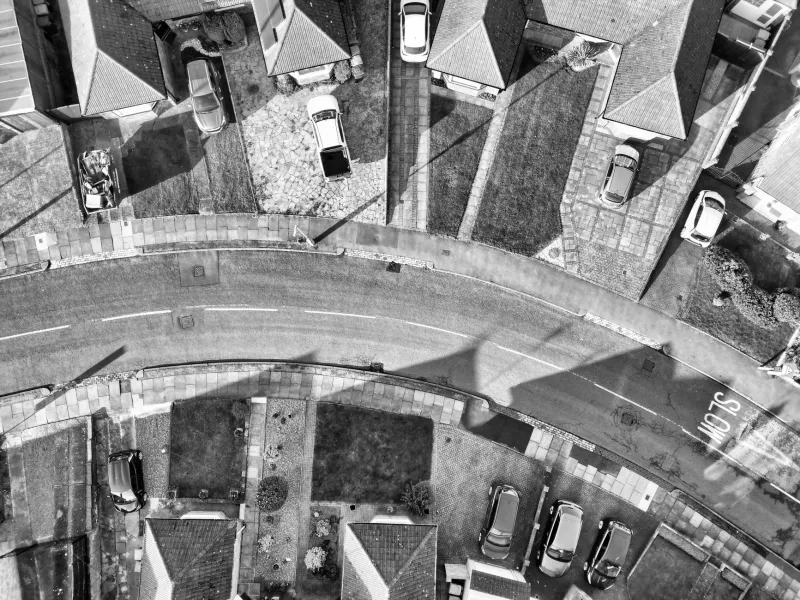
Built for the Van That Isn’t Yours: Driveway Design for Real-World Traffic
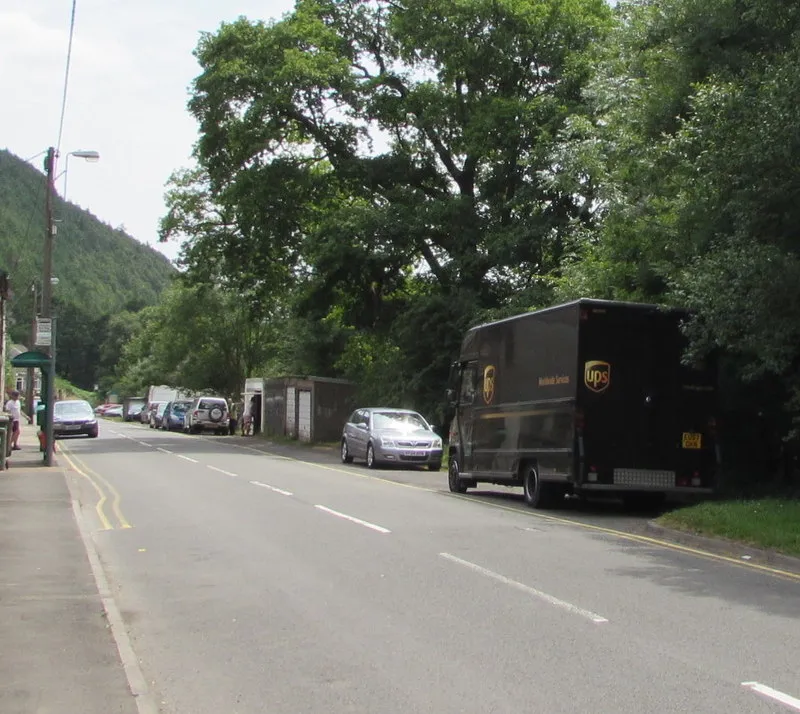
Photo: Jaggery , CC BY-SA 2.0, via Wikimedia Commons
When a driveway is being planned, the conversation nearly always starts with the car on the drive. Fair enough — it is the vehicle that will sit there most nights. But the traffic that actually tests a driveway is often the traffic nobody in the house owns: the supermarket van, the plumber’s Transit, the skip lorry that arrives at an awkward angle, and the removals wagon that turns up once a decade and expects a turning circle like a tennis court.
Designing for that heavier, clumsier traffic is not the same as turning the front garden into a commercial yard. It is about a handful of decisions — width, edges, base and a bit of turning room — made early enough to matter.
The vehicles you should picture
Most household cars weigh around 1.5 tonnes and spread that over four contact patches. A loaded 3.5-tonne delivery van does not. Add a tradesperson’s pickup with a rack and maybe a trailer, a 7.5-tonne skip lorry, or a removal van with a long rear overhang, and both the loads and the manoeuvring change completely.
The point is not to design for a daily diet of HGVs. It is to accept that a driveway is a working surface, not a showroom plinth. A sensible brief considers the routine car, the weekly delivery van, the occasional heavier vehicle, and the fact that none of those drivers knows your garden as well as you do.
Gate widths and the cost of a tight squeeze
A standard car is around 1.8 metres wide with mirrors folded. A van is wider, and the driver is usually watching a screen, a mirror and a gap that looks narrower from the cab than it does from the house.
Between gate piers, aim for at least 3 metres clear where vans are expected, and more if the approach is angled or the driver has to turn immediately after entering. Two and a half metres can work for cars, but it becomes a pinch point for deliveries. If the gate is narrower than the vehicle, the driver may stop in the road, reverse onto the pavement, or give up — none of which improves the front garden.
The same logic applies to the route from gate to parking. A driveway that widens only at the parking area but narrows to a car’s width at the entrance is still a narrow driveway. The van has to get through the narrow bit first.
Put the strength where the wheels go
A common mistake is to over-engineer every square metre because a heavy vehicle might one day use the drive. That is expensive and often unnecessary. A better approach is to strengthen the route the vehicle actually takes: the entrance apron, the path from gate to parking, and any turning area.
For cars, a well-compacted 150mm Type 1 sub-base is a familiar starting point. Where regular 3.5-tonne vans or occasional 7.5-tonne vehicles are expected, a 200mm sub-base with a geotextile separation layer is worth discussing. The difference is not about making the whole drive look like a lorry park; it is about preventing the ruts and settlement that appear first at the gate and along the wheel tracks.
Block paving can handle this traffic well when the base and edge restraint are right. Resin-bound surfaces can too, provided the sub-base is designed for the load rather than just the look. Gravel is the surface most likely to disappoint under a delivery van, because tyres push it aside and the driver ends up spinning for grip.
Edges and corners do the hard work
Heavy vehicles do not just press down; they push sideways. That is why edge restraint matters more than many homeowners expect. A line of blocks or setts sitting on sand is not an edge — it is decoration. A proper edge is haunched with concrete, deep enough and wide enough to resist lateral movement.
Corners take the worst of it. A van cutting a corner will clip the edge, and a skip lorry reversing will put a point load exactly where the paving is weakest. Solid edging, a generous haunch and a reinforced concrete apron near the gate are all sensible where the traffic is clumsy rather than malicious.
Turning room, or a planned reverse
If the driveway is long enough, a turning area at the top saves a lot of reversing onto the road. A 6-metre diameter circle is a useful guide for vans, though tight sites rarely allow it. Where space is limited, a planned reversing bay or a clear, unobstructed area is better than a hopeful sweep of paving that ends in a flower bed.
Bollards, planters and low walls can guide drivers away from corners, but they need to be visible and positioned where a van can actually see them. A beautiful oak planter that gets reversed into is not a design feature; it is a future repair.
Covers, drainage and the bits that get hit
Manhole covers and drainage channels sit in the traffic line more often than anyone intends. A domestic cover rated for a car may not enjoy a delivery van landing on it. Check the rating and set covers flush, with a proper surround. ACO-style channel drains are useful at the gate, but they need to be strong enough and cleaned before winter, not after the first flood.
A brief worth handing over
When you talk to a contractor, say what actually happens on the drive: the car, the regular delivery van, the occasional skip, the caravan, the trailer. Ask where the sub-base changes, how the edges are restrained, and what is under the gate apron. A good installer will not need to rebuild the whole front garden to answer those questions.
A driveway should look calm and domestic. It should also cope with the van that arrives on a wet Tuesday, stops in the wrong place, and leaves a week later than expected. Designing for that reality is not over-engineering — it is just planning for the traffic you are going to get.