Sightlines Before Kerbs: Laying Out a Driveway on a Fast Road
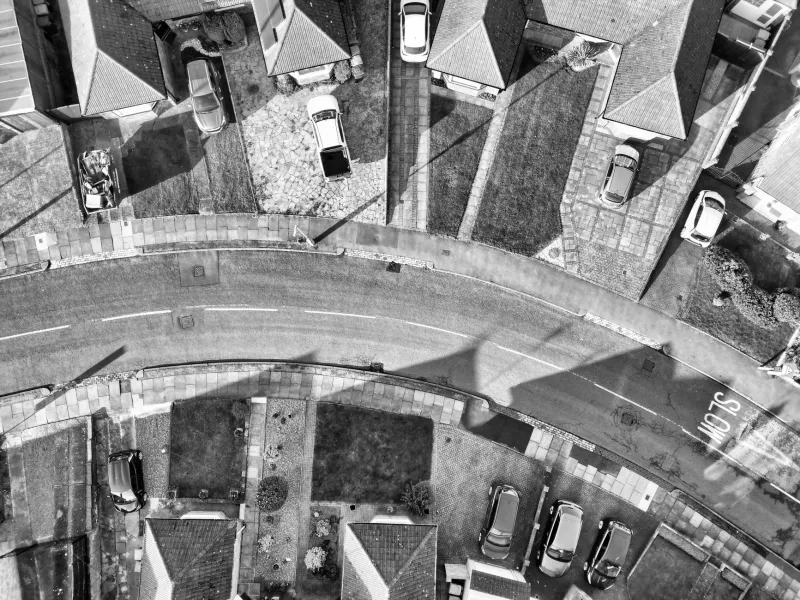
Most driveway conversations start with the surface. Block paving or resin, charcoal or buff, how it'll look against the brickwork. Fair enough. But if your front garden opens onto a road that never really goes quiet, the surface is the least interesting decision you'll make. The one that matters is whether you can get out of the car park at the end of it without holding your breath.
Reversing out onto a fast road is the bit that catches people. Not because drivers are reckless, but because you're doing the hardest manoeuvre in the book — blind, at an awkward angle, with a hedge in the way — into traffic that has no reason to expect you. A well-planned driveway takes that manoeuvre off the table. It's not highway engineering. It's just laying things out so the car, the wall and the road all agree with each other.
Why the reverse-out is the bit that bites
A driveway that's fine on a cul-de-sac is a different animal on a 40mph B-road. On a quiet street you can edge out, listen, take your time. On a busy one, the gap you were waiting for closes while you're still craning around the pillar.
The fix isn't a bigger mirror or a braver driver. It's designing the plot so you drive in forwards and leave forwards. That single change removes the worst-case manoeuvre, and it's worth trading a bit of lawn or a lot of shrubbery to get it.
Sightlines: measure what you can actually see, not what you hope
A visibility splay is the jargon for the triangle of clear view you need either side of the crossover. Every highway authority sets its own figures, and they scale with the speed of the road — a 30mph street needs far less than a 50mph one. You don't need to memorise the numbers, but you do need to understand the principle: the faster the traffic, the further back and further out you must be able to see, and the more of your boundary has to stay low and clear.
That has real consequences. The 1.8m wall you fancied? It might have to drop to a metre, or stop short of the splay entirely. The laurel that's been there thirty years? It may need a hard prune or a rethink. Hedges are lovely until they're the reason you can't see a van coming.
Get someone to stand at the driver's eye line in a car actually parked on the new driveway. Not roughly where it'll go — actually there. Then look both ways. If you can't see a cyclist at a sensible distance, the layout needs work before a single block goes down.
Turning space: the layouts that let you leave nose-first
This is where front gardens earn their keep. There are a few reliable approaches, and which one suits you depends on how much width you've got between the house and the kerb.
The in-and-out. Two cars side by side, or a wide apron with a reversing arc, so you swing in, straighten, and drive out the way you came. Needs a decent width — think three metres plus per bay, and enough apron depth to complete the turn without clipping the gatepost.
The L-shape or hammerhead. A short leg of paving running parallel to the house gives you somewhere to swing the nose round. It eats garden, but it's the difference between a relaxed exit and a daily gamble.
The set-back gate. Pulling the boundary back two or three metres buys you a standing area in front of the gate. You can wait there, nose out, until the road is clear. It's a small move with a big effect on how the drive feels.
The turning head. A proper T or circle at the top of the drive. More space, more cost, but it's the gold standard if the plot allows.
What none of these need is a huge forecourt. A modest front garden can usually be made to work if the layout is honest about the car's turning circle rather than pretending a three-point turn will do.
The crossover isn't the driveway
People say "dropped kerb" as if it's the whole job. It's one part, and it's governed by the council. The crossover — the bit between your boundary and the road — has to sit where the highway authority is happy with it. Not opposite a junction, not hard on a bend, not where it swallows a lamp post or a drain, and not so narrow that two cars can't pass on the pavement without a squeeze.
Position it where the sightlines are best, not where it's easiest to dig. Sometimes moving the entrance two metres along the frontage transforms the view up and down the road. That's a conversation to have before the design is fixed, not after.
When the road is genuinely too quick
There are plots where the honest answer is that no layout makes a fast, blind road comfortable. In those cases the sensible options are lowering boundary features to open up the view, keeping gates set well back so you never nose out blind, or accepting that the drive is for parking and the car leaves nose-first only at quieter times. A good contractor will tell you when the site is fighting you rather than sell you a layout that looks neat and drives badly.
The paperwork bit, briefly
Anything that involves dropping the kerb needs approval from the local highway authority, and they'll want to see the visibility splay and crossover position. Planning permission may come into it depending on the property and the road. It's not the glamorous end of the job, but it's the part that decides whether the finished drive is legal and safe or just pretty.
The takeaway
If your front garden meets a busy road, start with the exit, not the paving. Work out where you can see from, how the car will turn, and where the crossover needs to sit to give you the longest view. Then choose the stone. The driveway that lets you pull out forwards, calm and unhurried, is worth more than any surface on the market.