Colour, Grip and Gloom: Testing a Paving Sample Under Real British Conditions
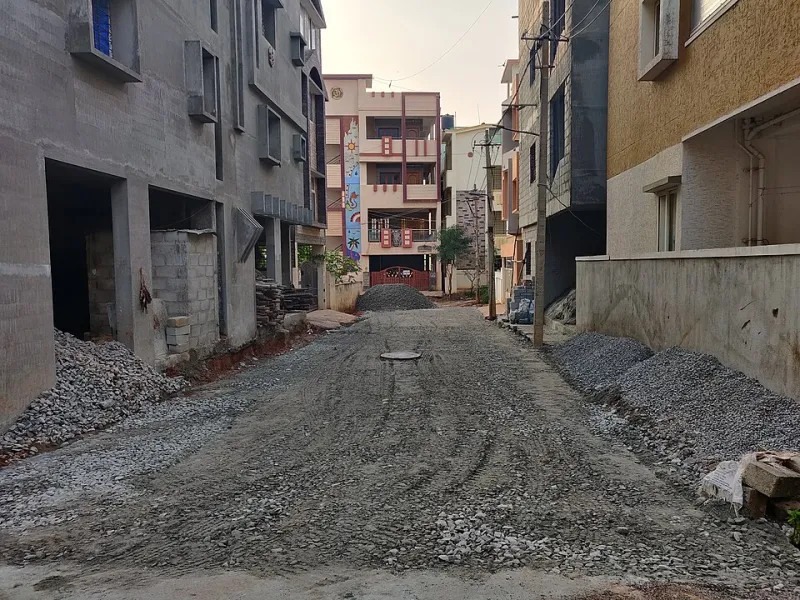
Photo: రవిచంద్ర, CC BY-SA 4.0, via Wikimedia Commons
A paving sample has a hard job. It has to convince you that a material will look right across the whole drive, in February drizzle, under a low winter sun, and beside a house that may not get much direct light. Most samples are asked to do this while dry, indoors, and roughly the size of a coaster. That is not really a fair test.
Paving is an outdoor purchase. It will spend much of its life damp, shaded or splashed, and you will usually see it from a doorway or a car rather than from six inches away. So before you sign off a surface, give the sample a proper audition. It takes half an hour and it can save a lot of second-guessing later.
Start with a sample that represents the real thing
A single small chip is useful for a rough idea, but it is not enough to judge colour or texture. Ask for a sample that is large enough to show the surface properly, and ideally ask for a couple of units from the current batch. Natural stone, concrete block paving and porcelain all vary slightly from batch to batch. Some variation is normal and often desirable; a sample that promises perfect uniformity is not telling you the whole story.
If you are comparing two materials, try to get samples of a similar size. It is easy to fall for the larger, fancier sample simply because it has more presence. You are buying the material, not the presentation box.
The bucket test beats the showroom every time
Wet the sample properly. A quick mist from a spray bottle is a start, but a ten-minute soak in a bucket or a good drenching with a watering can is closer to what British weather will do. Let the surface water settle, then look at it again.
Many stones darken significantly when wet. Some become richer and more characterful; others go flat, grey or patchy. Porcelain tends to change less, but it can still look different once water sits on the surface and light reflects off it. Block paving may show colour variation between units more clearly when damp. Resin-bound surfaces can look deeper and more uniform wet, then lighter and more open dry.
You want to like the material in both states. A driveway that only looks good dry is a gamble in this country.
Look from standing height, not nose-down
Place the sample on the ground where it will actually go, or as close as you can get. Step back a couple of metres. Then look at it from the height of your front door, your kitchen window or the driver's seat. This sounds obvious, but it changes everything. Close up, you see pattern and detail. From standing height, you see tone, contrast and whether the surface feels calm or busy.
This is also the moment to think about scale. A strong vein or a dramatic colour fleck can look lovely on a small sample and overwhelming across a whole driveway. A subtle surface that seems dull in the hand may be exactly right at full size.
Move it around the garden
Colour is not fixed. It changes with light. Put the sample in the sun, then in shade. Check it against the house wall, the fence and any existing paving. If your drive is north-facing or overshadowed by a hedge, test it there rather than in the brightest corner of the garden.
Overcast light is the default for much of the year, so do not ignore it. Some paving comes alive in direct sun and turns lifeless under a grey sky. Others look better in soft light. Neither is automatically wrong, but you should know which one you are buying.
Grip deserves more than a tick box
Slip resistance is not just a number on a brochure. Wet grip depends on the surface texture, the jointing, the drainage and how the paving is laid. Still, a wet sample gives you a useful reality check. Run a damp hand across it, or stand on it in the sort of shoes you actually wear. Smooth surfaces can be fine when clean and dry, but they are less forgiving once algae, moss or winter grime arrive.
Textured stone and porcelain often feel more reassuring underfoot, but texture also traps dirt. A riven surface may hide marks well; a honed surface may show every footprint. Think about who uses the drive or patio, how much shade it gets, and whether you are happy to clean it.
Joints change the picture
A sample laid without joints is only half the story. Joint width, jointing sand or mortar colour and the laying pattern all affect the final look. Pale joints on dark paving can create a strong grid; dark joints on pale paving can soften the whole surface. Herringbone, stack bond and large-format layouts all read differently from a doorway.
Ask to see the sample with a realistic joint gap, or look at a completed project using the same material. The joints are part of the visual texture, not an afterthought.
Ask about sealing and aftercare
Some sealers deepen colour and add a sheen; others are designed to be almost invisible. If you are considering a sealer, test it on an offcut rather than on the finished drive. Check whether the surface is expected to effloresce, how it should be cleaned, and what the manufacturer recommends for winter. A sample should come with a conversation, not just a price.
The questions worth asking before you commit
Can you keep the sample for a few days? Is it from the current batch? How much colour variation should you expect? What does it look like wet? What is the slip rating, and how does that change with contamination? Can you see a similar project nearby?
A good paving choice should still feel right on a wet Tuesday in February, not just under showroom lights. Wet it, shade it, stand back from it and imagine it covered in autumn leaves and a bit of winter grime. If it still looks good then, you are onto something.