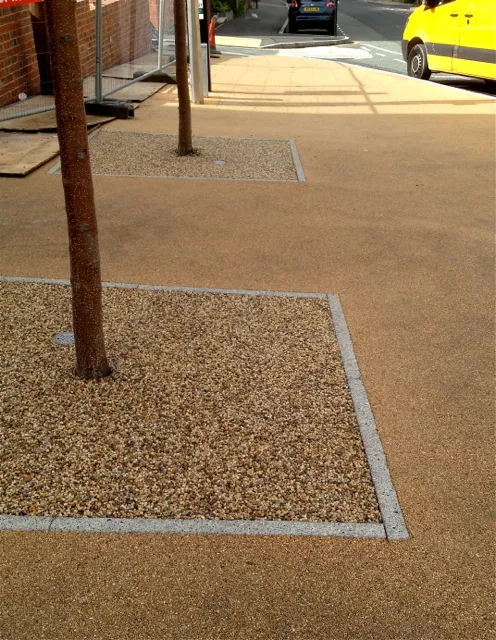
Front Garden Driveways: The Drainage and Permission Checks Worth Doing First
Photo: Tilman2007, CC BY-SA 4.0, via Wikimedia Commons
A front garden can look like the obvious place for another parking space. It is close to the house, it is already part of the property, and plenty of neighbours have done the same thing. But front garden driveways sit in a tricky spot: they are often the first place rainwater meets the house, the street and the drains. Get that bit wrong and a simple parking pad can turn into a planning conversation, a puddle at the door, or a retrofit that costs more than the original job.
At Hiskins Paving, we would rather have that conversation before the digger arrives. The good news is that most of the checks are simple. You do not need to become a drainage engineer overnight, but you do need to know what your driveway is doing with water — and what your local authority expects.
The rule in plain English
In England, most front garden hard surfaces can be installed under permitted development, but only if rainwater is dealt with properly. Broadly, the surface should either be permeable, or water should drain to a permeable area within the property, such as a lawn or border. If neither is true, planning permission is usually needed. That is the short version; the longer version depends on where you live and what kind of property you have.
Conservation areas, listed buildings, flats, rented properties and homes with restricted covenants can all change the picture. Scotland, Wales and Northern Ireland have their own rules. So before anyone quotes for block paving or resin, check the planning portal for your local council and, if in doubt, ask the planning department directly. A five-minute email is cheaper than undoing a driveway.
There is also a common misunderstanding about the word 'permeable'. It is not enough to buy a paving product with gaps or a fancy name. Water has to be able to pass through the full build-up and into the ground, or be stored and released slowly. If the sub-base is compacted, the joints are sealed, or the falls send water towards the house, the label on the paving does not help much.
Permeable paving is a system, not a product
This is where a lot of DIY and cheap-quote driveways come unstuck. A permeable driveway is a layered system: paving, jointing material, open-graded sub-base, geotextile, and the ground beneath. Each part has a job. The sub-base needs enough void space to hold water during heavy rain. The ground underneath needs to drain well enough to accept it. The edges need restraining, and the levels need to guide water away from the building — not into it.
On clay-heavy soils, or where the water table is high, a simple soakaway may not be enough. Sometimes an attenuation layer or a controlled outlet is needed. That is not a reason to panic; it is a reason to have the ground assessed. A contractor who turns up, paces the lawn and says 'permeable blocks will be fine' without asking where the water goes is not giving you a proper design.
Three checks to make before you request quotes
First, watch the rain. Where does water already sit? Does it run towards the house, the pavement or next door? Are there dips in the lawn? A driveway will change those patterns, so it helps to know the starting point.
Second, look at the boundaries and services. Manhole covers, gullies, downpipes, tree roots and utility boxes all affect the design. So does the width needed for a car door, bins and pedestrian access. A driveway that parks two cars but blocks the bin lorry is not a success.
Third, check the paperwork. Look at the title, any leasehold terms, and local planning guidance. If you are in a conservation area, ask whether hard surfacing is restricted. If the house is listed, get advice early. It is much easier to design around a restriction than to argue with it afterwards.
Mistakes that turn into costly retrofits
Sealing a permeable surface is one of the biggest. People do it to keep weeds down or make the driveway look tidy, then wonder why water pools. The joints are meant to let water through; sealing them defeats the point.
Another is using the wrong sub-base. Type 1 MOT is great for many things, but it is not an open-graded drainage layer. If the build-up is wrong, the driveway may look fine for a season and then show damp patches, movement or sinkage.
Poor falls are another common issue. A driveway should shed water away from the house and towards a suitable drainage point. If the levels are flat or tipped the wrong way, you get standing water and a much shorter lifespan for the surface.
Finally, ignoring the edges. Block paving and resin-bound surfaces need proper edge restraints. Without them, the surface can creep, open up and let water in. It is a small detail with a big effect.
What a proper contractor should show you
A good quote should explain the build-up, not just the surface. Ask where the water will go, how the sub-base will be specified, what happens at the edges, and how the work will tie into existing drains. Ask about waste removal, access and protection for the house. If the contractor cannot answer those questions clearly, keep looking.
A front garden driveway is not just a parking space. It is part of the drainage of your property. Get the permissions and the water side right, and the surface has a much better chance of earning its keep for years.