The Puddle Doesn't Lie: Diagnosing Driveway Drainage Without the Panic
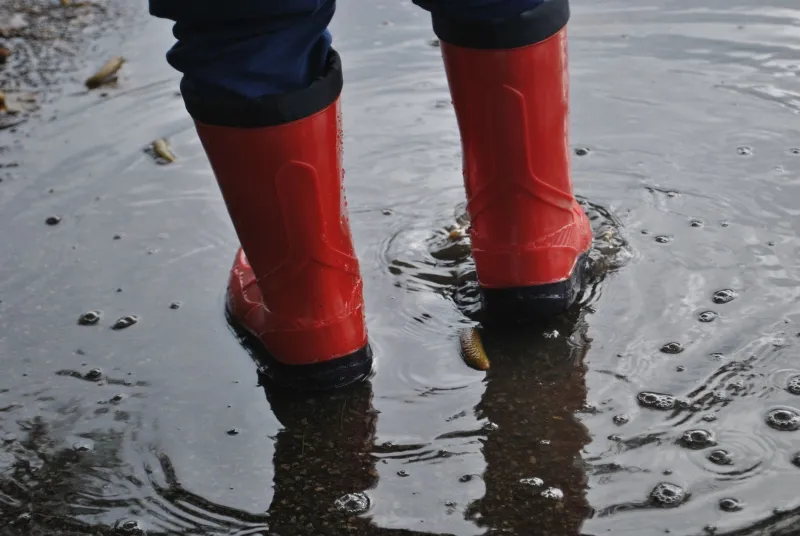
There's a particular kind of anxiety that arrives with the first proper autumn downpour. You look out of the kitchen window, see a sheet of water sitting on the drive, and immediately start imagining sub-base failures, sunken corners and a bill with too many zeros. Take a breath. Water on a driveway is not automatically a defect. It's evidence. And like most evidence, it's worth reading properly before you act on it.
Start with what normal actually looks like
No driveway is perfectly flat, and it isn't supposed to be. Paving needs a fall — typically somewhere around 1 in 60 to 1 in 80 for a driveway, steeper for some surfaces — so that water can find its way to a gully, channel or the edge of the plot. After heavy rain, a thin film of water that clears within an hour or two is doing exactly what it should. So is a shallow damp patch in a low corner that disappears before lunch.
The trouble starts when water stops moving. Standing water is a different animal from wet paving, and the difference is usually obvious within a couple of hours of the rain stopping.
The shape and position of the puddle tell you different things
A saucer-shaped pool in the middle of the drive, roughly where a car wheel sits, usually points to a localised low spot. That can be settlement in the sub-base, a patch that was never compacted properly, or simply a slight dip in the laying course. It's often cosmetic at first and becomes a real problem only when it deepens or starts holding water against a joint.
Water hugging the edge of the house or garage is more serious. If it's sitting against the wall rather than running away, the fall may be running the wrong way — sometimes by only a few millimetres across several metres, which is enough. That's the pattern to watch, because it puts water exactly where you least want it.
A puddle that forms a ring around a gully or drain, rather than draining into it, is almost always a blockage, a collapsed pipe or a gully set too high. Those are often straightforward fixes. Long, thin puddles following a line of joints suggest the paving has settled along a particular course. Water pooling at the bottom of a slope, where the drive meets the pavement, is a classic sign that the outlet has nowhere to go.
On a patio, look at the joints. Water sitting in the joints rather than running off the slabs is usually a sign that the fall is too shallow, the jointing material has failed, or both. If the puddle is only in one corner, it's local. If it's across the whole patio, the fall itself needs looking at.
Depth and duration are the two numbers worth remembering
You don't need a survey to make a sensible judgement. You need a rough idea of how deep the water gets and how long it stays.
Up to about 5mm, clearing within a couple of hours of the rain stopping, is a monitor-it situation. Note where it happens and check again after the next heavy spell. Water between roughly 10mm and 20mm that's still there the following morning is telling you something needs attention. Anything that reaches the brickwork, the door threshold or the damp-proof course is worth acting on promptly rather than waiting for spring.
A quick way to check depth without a ruler: a 20p coin is about 2mm thick, a standard house brick is around 65mm. If you can see a good chunk of brick under the water, you've got a genuine pool, not a damp patch.
What you can reasonably do yourself
Before you call anyone, do the simple things. Clear leaves and moss from gullies, check that downpipes are actually discharging where they should be, and lift any drain covers to see whether the problem is on the surface or below it. In autumn, a single sycamore or birch can fill a gully in a fortnight.
If the puddle disappears after you've cleared a gully, you've solved it. If the gully is clear and the water still sits, the issue is the fall or the drainage itself — and that's not a job for a pressure washer and optimism.
When it's time to get someone in
Call a contractor when water is consistently pooling to more than about 20mm, when it's sitting against the building, when the same spot returns after every serious rainfall, or when you can see movement — rocking slabs, sunken block courses, joints opening up. Those are signs that the surface layer is no longer doing its job, and patching over the top rarely lasts.
On clay ground, standing water is worth taking seriously earlier than you might think. Clay holds water, and repeated freeze-thaw cycles through a wet winter can lift and shift paving that looked fine in September. A small low spot that holds water in November can be a much bigger one by February.
The cost of waiting
The honest truth is that most drainage problems are cheap when they're small and expensive when they're ignored. Water sitting in joints washes out the bedding, encourages moss and weeds, and — in a hard frost — expands and prises paving apart. Water against a wall is worse. None of that happens overnight, but it does happen over a winter.
So next time it rains hard, put your coat on and have a look. Note where the water sits, how deep it gets and how long it takes to go. That five-minute survey is the cheapest diagnostic tool you've got, and it will tell you far more about your driveway than a panicked phone call ever could.